Wikipedia

Search results

Friday, April 24, 2020

The concept of hardware and software is explained in detail below

Hardware

The term hardware refers to mechanical device that makes up computer. Computer hardware consists of interconnected electronic devices that we can use to control computer’s operation, input and output. Examples of hardware are CPU, keyboard, mouse, hard disk, etc.
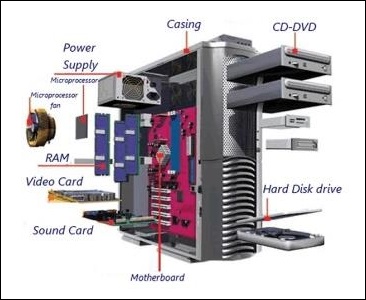
Computer Hardware Components

Hardware Components

Computer hardware is a collection of several components working together. Some parts are essential and others are added advantages. Computer hardware is made up of CPU and peripherals as shown in image below.
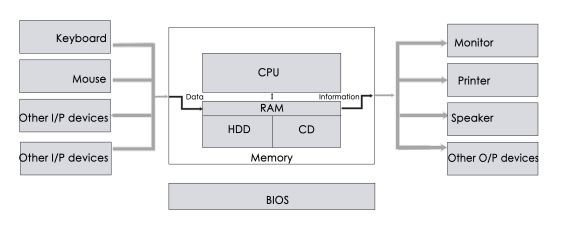
Computer Hardware Architecture

Software

A set of instructions that drives computer to do stipulated tasks is called a program. Software instructions are programmed in a computer language, translated into machine language, and executed by computer. Software can be categorized into two types −

  • System software
  • Application software

System Software

System software operates directly on hardware devices of computer. It provides a platform to run an application. It provides and supports user functionality. Examples of system software include operating systems such as Windows, Linux, Unix, etc.
System Software

Application Software

An application software is designed for benefit of users to perform one or more tasks. Examples of application software include Microsoft Word, Excel, PowerPoint, Oracle, etc.
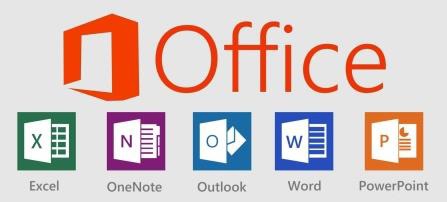
Application Software

Differences between Software and Hardware are sorted out below −

Sr.No.SoftwareHardware
1It is a collection of programs to bring computer hardware system into operation.It includes physical components of computer system.
2It includes numbers, alphabets, alphanumeric symbols, identifiers, keywords, etc.It consists of electronic components like ICs, diodes, registers, crystals, boards, insulators, etc.
3Software products evolve by adding new features to existing programs to support hardware.Hardware design is based on architectural decisions to make it work over a range of environmental conditions and time.
4It will vary as per computer and its built-in functions and programming language.It is mostly constructed for all types of computer systems.
5It is designed and developed by experienced programmers in high-level language.The hardware can understand only low-level language or machine language.
6It is represented in any high-level language such as BASIC, COBOL, C, C++, JAVA, etc.The hardware works only on binary codes 1’s and 0’s.Computer Data Transfer
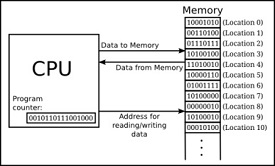
7The software is categorized as operating system, utilities, language processor, application software, etc.The hardware consists of input devices, output devices, memory, etc.

Monday, September 16, 2019

Friday, August 2, 2019

Transforming biology to design next-generation computers, using a surprise ingredient

Researchers turned to biology to help in the design of next-generation computers

Date:
July 25, 2019
Source:
Purdue University
Summary:
A group has found ways of transforming structures that occur naturally in cell membranes to create other architectures, like parallel 1nm-wide line segments, more applicable to computing.
Moore's law -- which says the number of components that could be etched onto the surface of a silicon wafer would double every two years -- has been the subject of recent debate. The quicker pace of computing advancements in the past decade have led some experts to say Moore's law, the brainchild of Intel co-founder Gordon Moore in the 1960s, no longer applies. Particularly of concern, next-generation computing devices require features smaller than 10 nanometers -- driving unsustainable increases in fabrication costs.
Biology creates features at sub-10nm scales routinely, but they are often structured in ways that are not useful for applications like computing. A Purdue University group has found ways of transforming structures that occur naturally in cell membranes to create other architectures, like parallel 1nm-wide line segments, more applicable to computing.
Inspired by biological cell membranes, Purdue researchers in the Claridge Research Group have developed surfaces that act as molecular-scale blueprints for unpacking and aligning nanoscale components for next-generation computers. The secret ingredient? Water, in tiny amounts.
"Biology has an amazing tool kit for embedding chemical information in a surface," said Shelley Claridge, a recently tenured faculty member in chemistry and biomedical engineering at Purdue, who leads a group of nanomaterials researchers. "What we're finding is that these instructions can become even more powerful in nonbiological settings, where water is scarce."
In work just published in Chem, sister journal to Cell, the group has found that stripes of lipids can unpack and order flexible gold nanowires with diameters of just 2 nm, over areas corresponding to many millions of molecules in the template surface.
"The real surprise was the importance of water," Claridge said. "Your body is mostly water, so the molecules in your cell membranes depend on it to function. Even after we transform the membrane structure in a way that's very nonbiological and dry it out, these molecules can pull enough water out of dry winter air to do their job."
Their work aligns with Purdue's Giant Leaps celebration, celebrating the global advancements in sustainability as part of Purdue's 150th anniversary. Sustainability is one of the four themes of the yearlong celebration's Ideas Festival, designed to showcase Purdue as an intellectual center solving real-world issues.
The research team is working with the Purdue Research Foundation Office of Technology Commercialization to patent their work. They are looking for partners for continued research and to take the technology to market.

Monday, July 29, 2019

           A computer is a machine that can be instructed to carry out sequences of arithmetic or logical operations automatically via computer programming. Modern computers have the ability to follow generalized sets of operations, called programs. These programs enable computers to perform an extremely wide range of tasks. A "complete" computer including the hardware, the operating system (main software), and peripheral equipment required and used for "full" operation can be referred to as a computer system. This term may as well be used for a group of computers that are connected and work together, in particular a computer network or computer cluster.
Computers are used as control systems for a wide variety of industrial and consumer devices. This includes simple special purpose devices like microwave ovens and remote controls, factory devices such as industrial robots and computer-aided design, and also general purpose devices like personal computers and mobile devices such as smartphones. The Internet is run on computers and it connects hundreds of millions of other computers and their users.
Early computers were only conceived as calculating devices. Since ancient times, simple manual devices like the abacusaided people in doing calculations. Early in the Industrial Revolution, some mechanical devices were built to automate long tedious tasks, such as guiding patterns for looms. More sophisticated electrical machines did specialized analogcalculations in the early 20th century. The first digital electronic calculating machines were developed during World War II. The speed, power, and versatility of computers have been increasing dramatically ever since then.
Conventionally, a modern computer consists of at least one processing element, typically a central processing unit (CPU), and some form of memory. The processing element carries out arithmetic and logical operations, and a sequencing and control unit can change the order of operations in response to stored informationPeripheral devices include input devices (keyboards, mice, joystick, etc.), output devices (monitor screens, printers, etc.), and input/output devices that perform both functions (e.g., the 2000s-era touchscreen). Peripheral devices allow information to be retrieved from an external source and they enable the result of operations to be saved and retrieved.

The concept of hardware and software is explained in detail below

Hardware The term hardware refers to mechanical device that makes up computer. Computer hardware consists of interconnected electronic devic...